

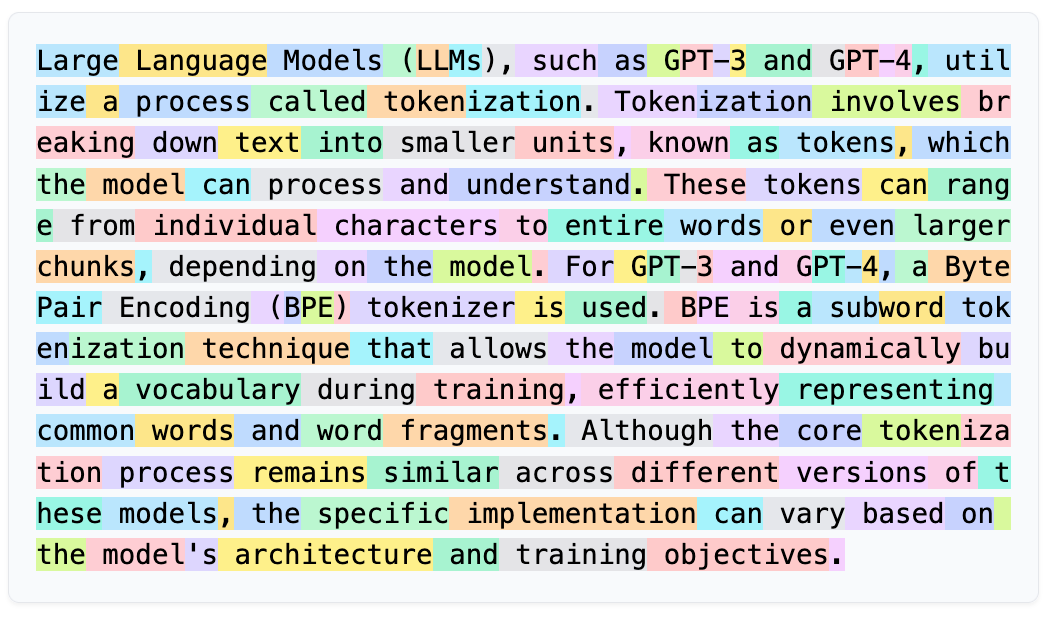

Tokenization is a foundational step in Natural Language Processing (NLP). Whether you’re building a sentiment analysis model, a text classifier, or a large language model (LLM) like GPT, understanding tokenization is essential.
At which stage in the ML Workflow does Tokenization typically occur ?

What Is Tokenization?
Tokenization is the process of converts raw text (which is inherently unstructured data) into structured form of tokens, and each token is often mapped to a numeric ID (sometimes called a vocabulary index).
Why Do We Need Tokenization?
| Reason | Explanation |
|---|---|
| Model Input | Machine learning and deep learning models operate on numerical data. Tokenization is the step that converts raw text into numerical IDs. |
| Vocabulary Building | Tokenization determines which tokens appear in your vocabulary, influencing embedding sizes and handling of unseen words. |
| Handling Language Variations | Helps manage text in languages with no spaces (Chinese, Japanese) and accommodates morphological differences (e.g., plurals, tenses). |
| Reducing Out-of-Vocabulary | Subword tokenization in particular reduces the OOV problem by splitting rare or unknown words into smaller, more frequent units. |
| Preprocessing Efficiency | Ensures consistent tokens for the model, speeding up learning and improving performance. |
Types of Tokenization
Sentence
“I love cats !”
- Word-level Tokenization
A word-level tokenizer splits text using spaces and punctuation marks. For instance, the sentence:
[“I”, “love”, “cats”, “!”]
- Subword Tokenization (BPE / WordPiece / SentencePiece)
In modern NLP—especially for Transformers and LLMs—subword tokenization is dominant. It strikes a balance between word-level and character-level approaches by splitting rare words into more frequent “subwords”:
- Byte-Pair Encoding (BPE): Greedily merges character pairs to form subwords.
- WordPiece: Used by models like BERT; merges subwords based on maximum likelihood of subword sequences.
- SentencePiece: A newer approach that can handle whitespace uniformly, commonly used by T5 and XLNet.
For example, with subword tokenization (using WordPiece):
[“I”, “lo”, “##ve”, “cat”, “##s”, “!”]
(Note: “##” is sometimes used in WordPiece to indicate subword continuity.)
- Character-level Tokenization
Here, the text is split into individual characters, including punctuation and special symbols. For example:
[“I”, “ “, “l”, “o”, “v”, “e”, “ “, “c”, “a”, “t”, “s”, “!”]
- Byte-level Tokenization
Popularized by GPT-2 and GPT-3, byte-level tokenization (e.g., Byte-Level BPE) treats text as a stream of raw bytes, effectively capturing every character. This approach can handle nearly all text variations, special Unicode characters, and emojis.
What If the Word Is Not in the Vocabulary? (Out-of-Vocabulary, OOV)
Out-of-vocabulary (OOV) refers to any word or token that does not appear in a model’s known vocabulary. If the model encounters a brand-new slang term, a rare technical term, or a spelling variant it hasn’t seen before, that word is considered out-of-vocabulary.
This can lead to:
- Misclassifications: The model may produce incorrect predictions if it can’t properly understand the missing word.
- “Unknown” [UNK] Token Outputs: Traditional tokenizers or older NLP models might label the entire word as UNK.
How Modern Approaches Handle OOV ?
- Subword Tokenization: Methods like BPE, WordPiece, and SentencePiece minimize OOV issues by splitting rare words into smaller, more familiar subword units. Even if the entire word is new, at least part of it is recognized.
- Character or Byte-level Tokenization: By tokenizing at the character or byte level, you effectively eliminate OOV problems—though you pay a price in longer token sequences and potentially slower training.
OOV handling is critical for real-world applications. Language evolves quickly, with new terms, slang, and domain-specific jargon appearing regularly. Choosing a tokenizer that gracefully manages these unseen words helps maintain model performance as your input data evolves.
Tools & Libraries
- Hugging Face Transformers: Provides state-of-the-art tokenizers (e.g., BERT, GPT, RoBERTa) and includes the tokenizers library for custom training.
- NLTK (Natural Language Toolkit): Offers basic word and sentence tokenizers.
- SpaCy>: Efficient, production-ready tokenization for multiple languages.
- SentencePiece: Framework for language-independent subword tokenization.
- Byte-Pair Encoding (BPE) : Often implemented in the above libraries or in standalone scripts.
Summary



Commentaires